
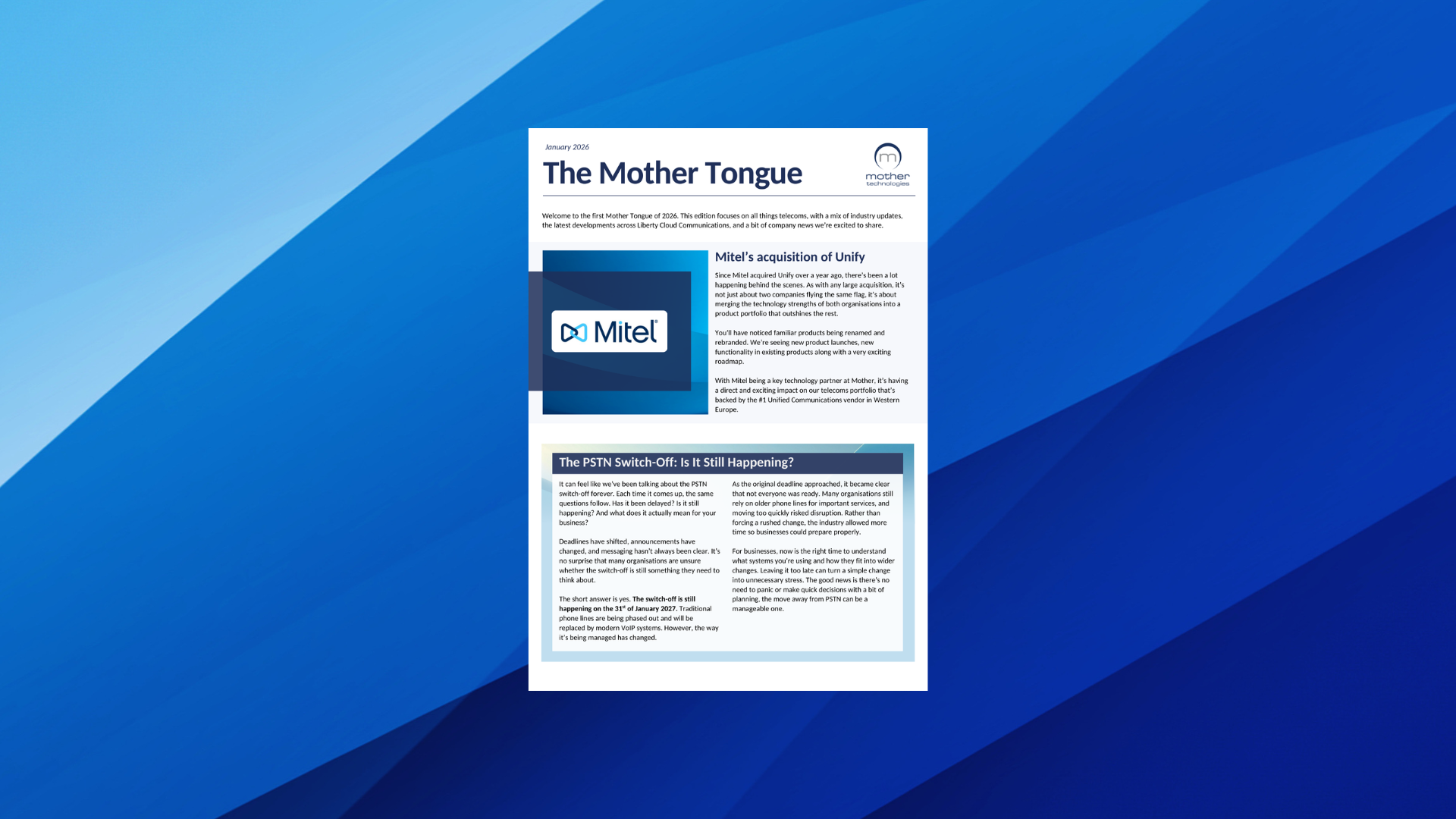
The Mother Tongue January 2026
Welcome to the first Mother Tongue of 2026. This edition focuses on all things telecoms, with a mix of industry
Depending on who you are talking to, AI is either the greatest tool ever, or it is the beginning of the end of meaningful work. The reality is it is somewhere in between.
We are going to take a deep dive into AI in this edition, highlighting what we think its genuinely good at, where it falls short and how it is being adopted by organisations.
Many organisations are using AI in their day to day work. Organisations are using it to streamline processes, reduce manual workload, and improve the speed of output.
Common uses of AI include:
The impact is clear, a task that previously took hours, can often be shortened to a quarter of the time. Across an entire business, this time saving quickly translates into reduced bottlenecks and time to focus on what actually moves your business forward.
AI in this context is not about replacing people or removing human interaction, it’s about removing hurdles.

We have been speaking to a lot of our customers about Microsoft Copilot recently. What is it? Does my business need it? How can it help?
Copilot brings AI into the M365 apps you probably use every day, including Word, Excel, PowerPoint, Outlook and Teams. It can help draft documents, summarise emails and make sense of data.
It’s not there to replace your team, but it’s a great tool to save time and make everyday tasks quicker and easier, like we already mentioned above.
There’s currently a promotion running on Copilot Business, with discounted pricing available until 30 June 2026. Microsoft has also made it easier to get started without waiting for your renewal date, and there’s now a flexible monthly billing option for businesses that want a lower-commitment starting point.
If you’re curious about what Copilot could look like in your organisation, or want to understand the current offer, speak to our sales team.
AI isn’t just helping with documents and emails, it’s increasingly present in meetings too.
In Teams, AI transcription can create written summaries and full transcripts of calls. It helps participants focus on the conversation instead of scrambling to take notes and makes it easy to revisit key points later. But it’s not always perfectly accurate, and not everyone is comfortable being recorded or transcribed.
Teams notifies participants whenever transcription or recording is active, and anyone in the meeting can ask for it to be turned off, giving people control over their privacy. However, some other AI transcription tools, such as Fathom, may offer less visibility about when participants are being recorded, making it especially important to be aware of how these tools are used.
These tools can add value, but they also change the dynamic of a conversation. As with all AI features, awareness and consent matter.
Just because it’s available, doesn’t mean it’s always appropriate. Think about the type of meeting you are having and who you are having it with.

It’s important to understand how AI models work.
They are trained on large volumes of publicly available information on the internet. As with any online sources, that includes high-quality material, but it also includes outdated, inaccurate, or poorly written content, think Wikipedia!
AI systems are designed to be helpful and responsive and do not like to say “I don’t know”. As a result, in situations where information is unclear, they may produce something that sounds plausible, even if it is not entirely correct.
This is particularly important in technical or professional areas. For example, AI can assist with straightforward coding tasks, summarising research, or drafting standard contracts.
But more complex problems still require experienced professionals who understand context, regulation and security. Public sources contain both expert and beginner work, and AI models trained to gather data from both of these!
AI is an effective brainstorming partner. However, it’s not a replacement for professional knowledge. We have already seen examples of organisations accepting AI-generated information at face value, only to discover later that it was incomplete or inaccurate.
As our Systems Engineer Martin puts it: “Use AI as a tool — and don’t let it use you as one. We have a brain, use it.”
Another area raising concern is data exposure and security.
There has been a growing trend online where individuals ask AI tools to generate content or images based on “everything you know about me.” While this may seem harmless, it highlights a broader issue.
When personal or professional information is entered into AI platforms, that data is being shared with a third party.
This raises a few points to keep in mind:
And as for businesses, the stakes are significantly higher.

If employees upload internal documents, client data, sensitive material, or regulated information into AI tools without thinking, the organisation may face:
AI tools are powerful, but they also reflect the data you put in.
Before using AI at work, ask yourself:
One of the growing consequences of AI growth is the impact it is going to start having on hardware markets.
Large AI systems built by organisations such as OpenAI, Google and Microsoft require enormous volumes of RAM, high-performance servers, GPUs, and networking infrastructure.
Not just marginal increases, but an unprecedented scale.
When a few AI companies start buying hundreds of thousands of memory units at once, there isn’t enough supply to go around. Since only a small number of companies make RAM worldwide, higher demand leads to higher prices. This is already starting to have effects:
Suppliers like Cisco and HPE can now adjust prices if the market changes. In the past, hardware buying was predictable: you ordered, agreed on a price, and received it. That’s no longer guaranteed.
All types of organisations will be affected because laptops, servers, cloud, and networking all rely on the same global supply chains. When costs or shortages happen upstream, everyone starts to feel it.
There’s no need to panic, but there is a need to plan.
By planning upgrades, forecasting demand, and timing purchases carefully, Mother helps reduce the impact of price changes and delays. In today’s market, planning ahead is no longer optional, but risk management.
AI is no longer a novelty. It’s become part of daily work. It can draft reports, summarise meeting notes, clean up spreadsheets, or organise large amounts of information in seconds. That means your team can spend less time on repetitive tasks and more time on work that actually moves the business forward.
But AI isn’t magic. It can make mistakes, misinterpret context, or produce content that looks confident but is wrong. Human judgement and expertise are essential to catch errors and ensure quality outcomes.
The trick is knowing where AI actually helps. Use it to speed up research, generate first drafts, or automate routine tasks, but keep the important stuff in human hands.
The key takeaway here is to treat AI as an assistant, not a replacement. The businesses that get the most value are those that can clearly define which tasks AI handles, which tasks humans handle, and where the two work hand in hand. When you get that balance right, your team will work smarter and faster.

AI is moving fast. Tools today could be outdated in just a few months, and new platforms keep appearing almost weekly! Many of these new solutions promise efficiency, but not all are actually reliable, secure, or designed for business use.
This makes evaluation of these tools essential. Instead of chasing every new tool, organisations should focus on identifying which AI platforms genuinely add value, meet security standards, and fit in with their workflows.
Regulation is also catching up. Governments and professional bodies are setting clearer rules around data privacy, transparency, and accountability when inputting sensitive information into these platforms, so businesses that plan ahead will avoid risks and stay compliant.
Overall, treat AI adoption like any other business decision or change. Set standards for evaluation, guide your teams on safe and effective use, and build systems where AI supports the business without introducing unnecessary risk.
Welcome to the first Mother Tongue of 2026. This edition focuses on all things telecoms, with a mix of industry
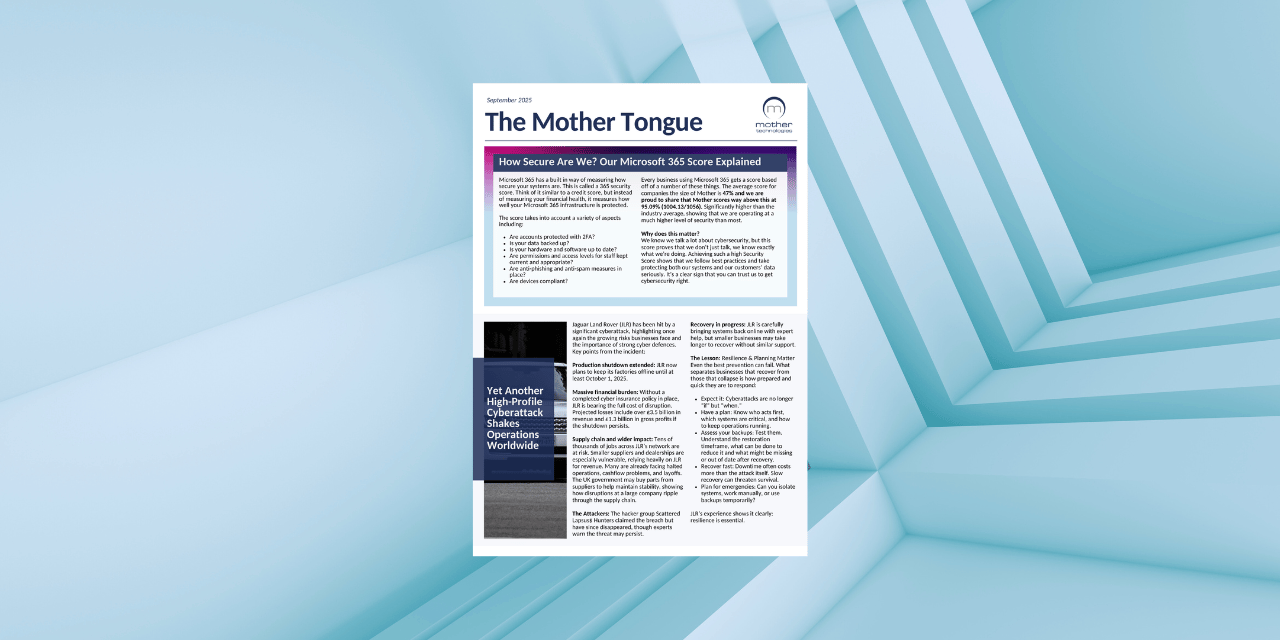
From Jaguar Land Rover’s global cyberattack to Starlink Connectivity, plus updates on our own performance, onboarding, and support improvements, this
Sign up to receive every edition of The Mother Tongue straight to your inbox.